Real
Captured in occupied buildings
Everyday human motion in offices, hotels and care settings — not actors in a lab.

For physical AI & research labs
How people actually use a building can't be scraped from the web. It has to be observed, over time, in real rooms. Aqusense starts that clock the day the sensors go up.
Aqusense detects presence and motion activity in monitored spaces without requiring cameras or wearables. This spatial context could complement a robot's cameras and lidar, or support building systems and wayfinding. These are potential integrations: coverage, application behaviour and performance require validation, not individual identification, persistent tracking or trajectory prediction.
Partner & member of




Aqusense for Physical AI
Aqusense detects presence and motion activity within monitored spaces without requiring cameras or wearables. This area-level spatial intelligence could complement cameras and lidar for autonomous robots, building systems and wayfinding. The illustration explores potential integrations—not validated navigation, safety or person-tracking capabilities.

Which monitored areas are occupied?
Presence · Human Presence Detection. Detect human presence in monitored rooms and zones using Wi-Fi signals, without requiring cameras or wearables. Area-level context could complement a robot's own cameras and lidar; integration and coverage require validation.
Potential robot responsesnot a live integration
Illustrative area eventsconceptual feed
Conceptual robotics integration · simulated data · no individual identification or persistent tracking.
Why this data is different
Real
Everyday human motion in offices, hotels and care settings — not actors in a lab.
Continuous
Every deployed floor adds hours of observation. Longer observation captures more patterns of use.
Clean
No images or audio are collected. Research use still requires a privacy and data-rights review.
Consented
Research use and permissions are agreed with the building owner before data is shared.
From one floor to a portfolio
Start with one floor and your robots see beyond their cameras. Add the building and your fleet works every floor. Across a portfolio, the same privacy-safe data layer becomes the record of how real spaces are used, ready for simulation and world models.

A robot on this floor knows where people are, beyond its own camera, and moves around them.
Your first live feed: presence and motion per zone, with confidence, via API or MQTT.
Illustrative: 50 seats per floor at 40% average occupancy over 2,500 working hours a year; 10 floors per building; 50 buildings. Anonymous presence and motion time series, not video, and never identity.
The layer vision can't capture
Radio signals interact with concrete, drywall, glass and steel. Every deployment records how Wi-Fi behaves in real materials and layouts — a physical signature of the space that complements the vision systems physical AI is built on.
Swipe sideways to read the full comparison.
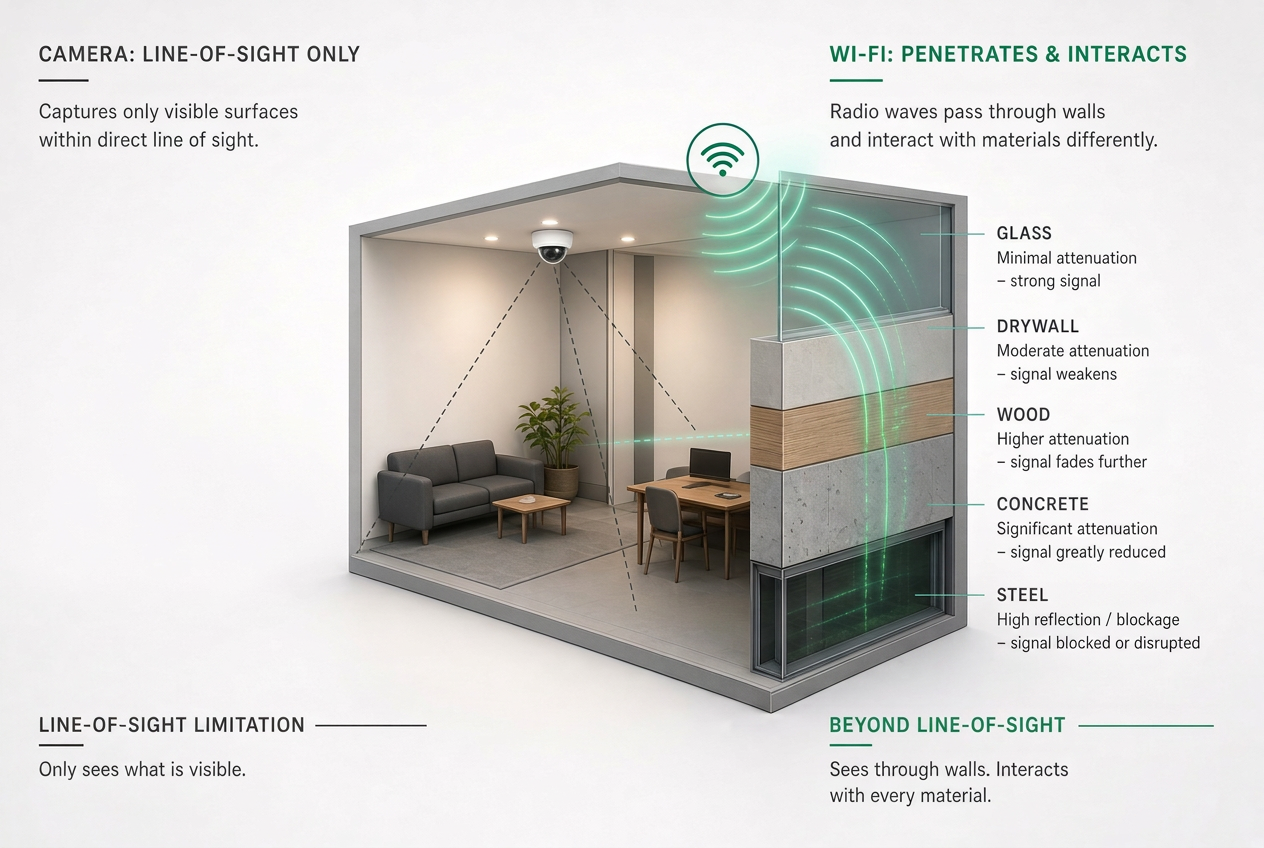
Open air
Glass
Drywall
Wood
Concrete
Steel
Vision plus RF: a fuller model of the physical world than either can build alone.
Ways to work with us
Licensed motion and occupancy datasets from consenting buildings
Built for
Physical AI and robotics teams training spatial models
Joint studies on RF sensing, privacy and benchmarks
Built for
Universities and standards researchers
Custom inference on Aqusense signals via API
Built for
Product teams building on spatial intelligence
Get an estimate in a minute, then book a demo.
Latest news
Blog · Sep 30, 2026
Blog · Sep 25, 2026

Events · Apr 14, 2026

Media · Oct 17, 2025