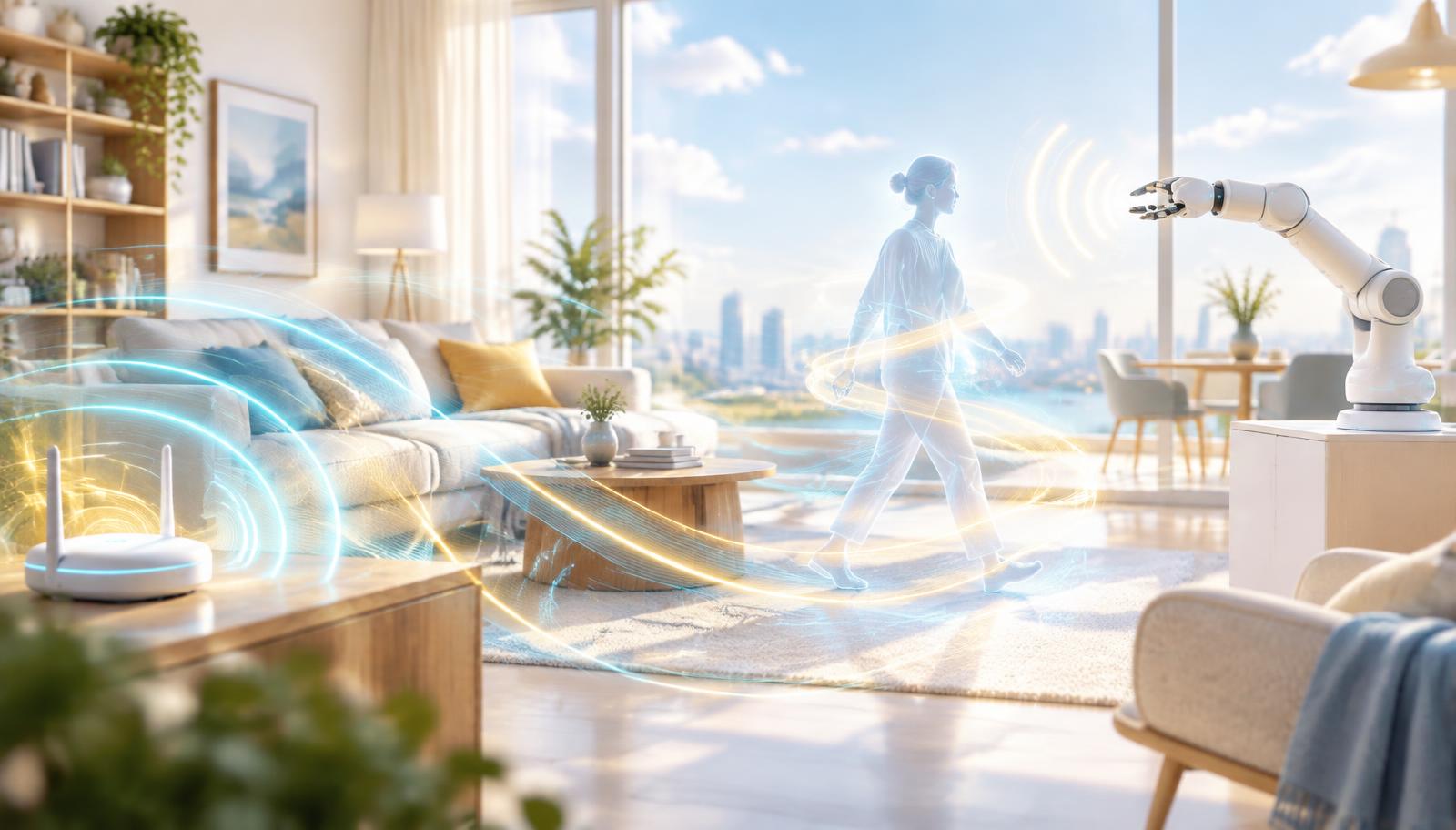
Where Wi-Fi Sensing Meets Physical AI: What We're Seeing at the Convergence
An opinion piece by Serb Jodha & Tom Mathai
Two waves, starting to meet
Some of the most interesting moments in technology happen when two separate waves of innovation begin to overlap. We think one of those moments may be starting right now.
The first wave is Wi-Fi sensing: the idea that the wireless signals already filling our buildings can tell us something about the spaces they travel through. It has moved from university labs into international standards and real commercial deals.
The second wave is physical AI: machines and systems that understand and act in the real world, from humanoid robots to buildings that respond to the people inside them. It has become one of the most energetic areas in all of AI.
From where we sit, working day to day with wireless sensing, these two waves are beginning to converge. We don't claim to know exactly where that leads. But what we're observing is exciting enough that we wanted to share it.
Wi-Fi is learning a new skill
Wi-Fi was designed to move data. But radio waves also interact with everything around them. When someone walks into a room, the way the signal travels through that room changes slightly, and those changes can be measured.
Wi-Fi sensing is the practice of reading those changes to understand what's happening in a space: whether it's occupied, whether there's movement, and how it's being used. The basic idea looks like this:
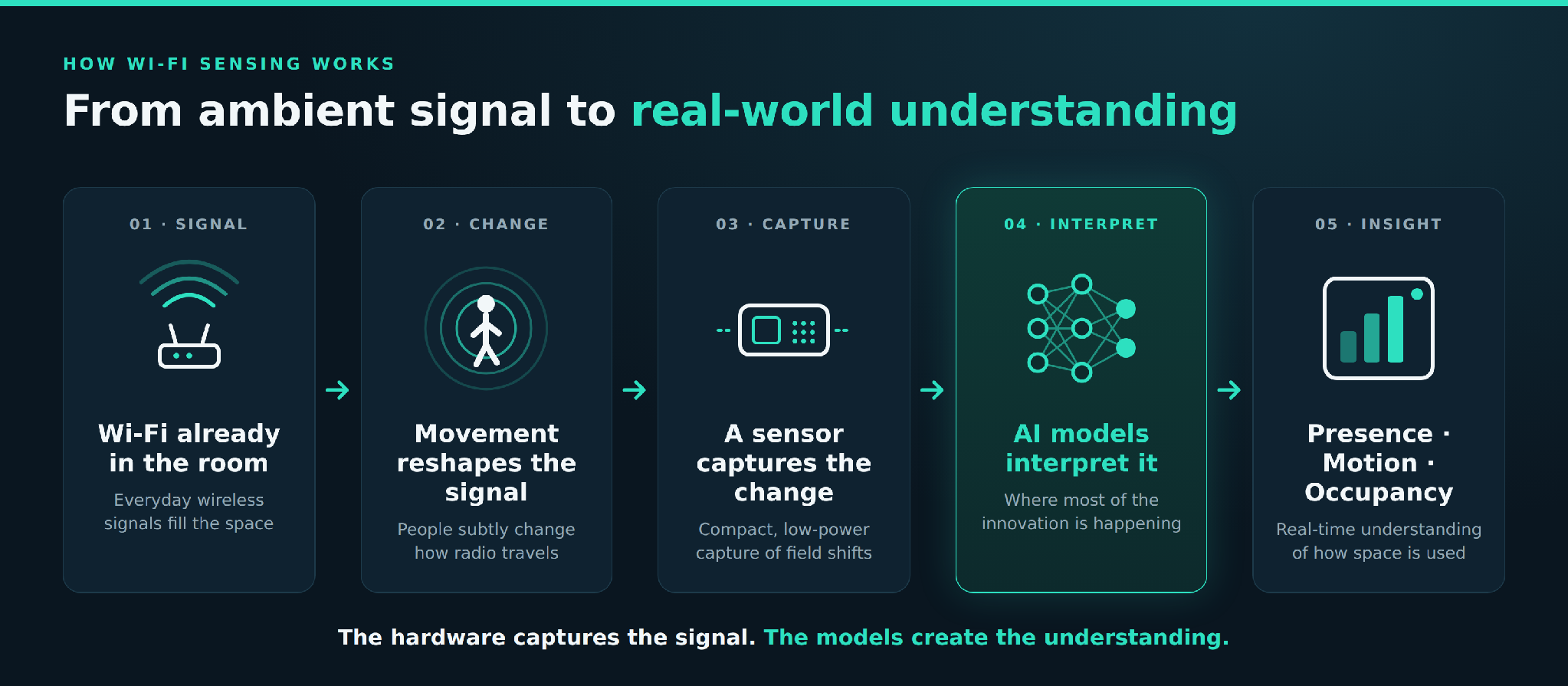
What strikes us most is where the real work happens. Capturing the signal is only the start. Every room shapes radio waves differently, so turning those signals into dependable answers is largely an AI challenge. That's why progress in this field increasingly tracks progress in machine learning.
It's also why the approach feels so promising. It builds on infrastructure buildings already have, it asks nothing of the people in the space, and radio can reach areas other sensors struggle to cover.
Where occupancy insight starts to matter
Presence, motion and occupancy can sound like small signals. Yet when we talk with building owners, operators and technology partners, we keep hearing how many everyday decisions depend on them.
| Sector | What people want to know | What it could unlock |
|---|---|---|
| Commercial real estate | Which floors, rooms and desks are actually used | Smarter leasing and right-sized space |
| Energy and HVAC | Where people are, right now | Heating, cooling and lighting that follow real occupancy |
| Workplace operations | How space is used across the day | Cleaning, booking and planning based on real demand |
| Building safety | Whether a space is occupied | Better-informed emergency response |
| Healthcare and senior living | Movement and activity patterns | Timely alerts that support independent living |
| Hospitality | Room and common-area occupancy | Better-timed service and energy savings |
| Industrial and logistics | Where people are relative to machines | Safer, more productive human–robot teamwork |
We've been surprised by how quickly value can show up. In a live deployment with one of Canada's largest commercial real estate companies, at its Toronto headquarters, Wi-Fi sensing agreed with a verified occupancy baseline more than 88% of the time and highlighted that 26% of the space was going unused. That's a real estate and energy conversation that simply wasn't visible before.
None of this replaces the tools buildings already use. Badge systems, motion sensors and network analytics each capture part of the picture. What we're seeing is Wi-Fi sensing adding a new, continuous layer alongside them.
The momentum we're watching
Wi-Fi sensing has been studied for more than a decade. What has changed recently is the pace. Over the past year or so, a handful of developments caught our attention because they come from very different corners of the industry.
| When | What happened | Why it caught our eye |
|---|---|---|
| Jun 2026 | NVIDIA launched Cosmos 3, an open world foundation model for physical AI | NVIDIA's CEO said the “big bang of physical AI is just around the corner” |
| Feb 2026 | ADT acquired Origin AI for $170M in cash | A major security provider invested in Wi-Fi-based presence and activity sensing, including 200+ patents, with new offerings planned from 2027 |
| Sep 2025 | IEEE published 802.11bf-2025, the Wi-Fi sensing amendment | Sensing became part of the official Wi-Fi standard |
| Sep 2025 | Figure partnered with Brookfield to build a humanoid pretraining dataset | A $1T+ asset manager opened homes, offices and logistics space to help robots learn, and invested in Figure's Series C |
On their own, each is a notable headline. Side by side, they suggest something bigger. Wi-Fi sensing is gaining standards and serious investment. Physical AI is maturing quickly. And its builders are going into real buildings to find the experience their models need.
One nuance we find encouraging: 802.11bf standardizes how devices share sensing measurements, but it leaves the interpretation to AI. Meanwhile, sensing can already run on the Wi-Fi installed today. That leaves a lot of room for innovation on the intelligence side.
Where the two waves overlap
Here's the part that excites us most. Physical AI needs to learn how people actually use real spaces. As NVIDIA noted when it launched Cosmos, physical AI models need vast amounts of real-world data. Wi-Fi sensing happens to produce exactly that kind of signal, continuously, in ordinary buildings.
A few observations keep coming up for us:
- The infrastructure is already there. Offices, hospitals, hotels and warehouses are full of Wi-Fi. Sensing can build on it rather than start from scratch.
- It reflects everyday reality. Because it runs in the background of normal life, it captures how spaces are really used, not staged scenarios.
- The signals line up. Presence, motion and spatial context are the same things a robot or autonomous building needs to work well around people.
We also notice that the capability seems to grow in layers, often on the same installed hardware:
| Layer | Question it answers | Where the industry is today |
|---|---|---|
| Presence | Is someone there? | Working in live deployments |
| Motion | How are they moving? | Working in live deployments |
| Activity | What is happening in the space? | Emerging |
| Context | How is the environment behaving? | Emerging |
| Physical AI | What should a machine understand about this space? | The open frontier |
If that pattern holds, each step forward could come from better models rather than new equipment. That's a different kind of growth curve, and one we find very compelling.
What we're learning in the field
At Aqusense, we've spent our time building sensors, software and AI models for Wi-Fi sensing, and putting them into real buildings. That hands-on view has shaped how we think about this space.
The biggest lesson so far: every building is different. Each one has its own wireless character, shaped by its walls, furniture and layout. That makes every new environment a chance to learn something.
It also suggests a loop that could gather momentum over time:
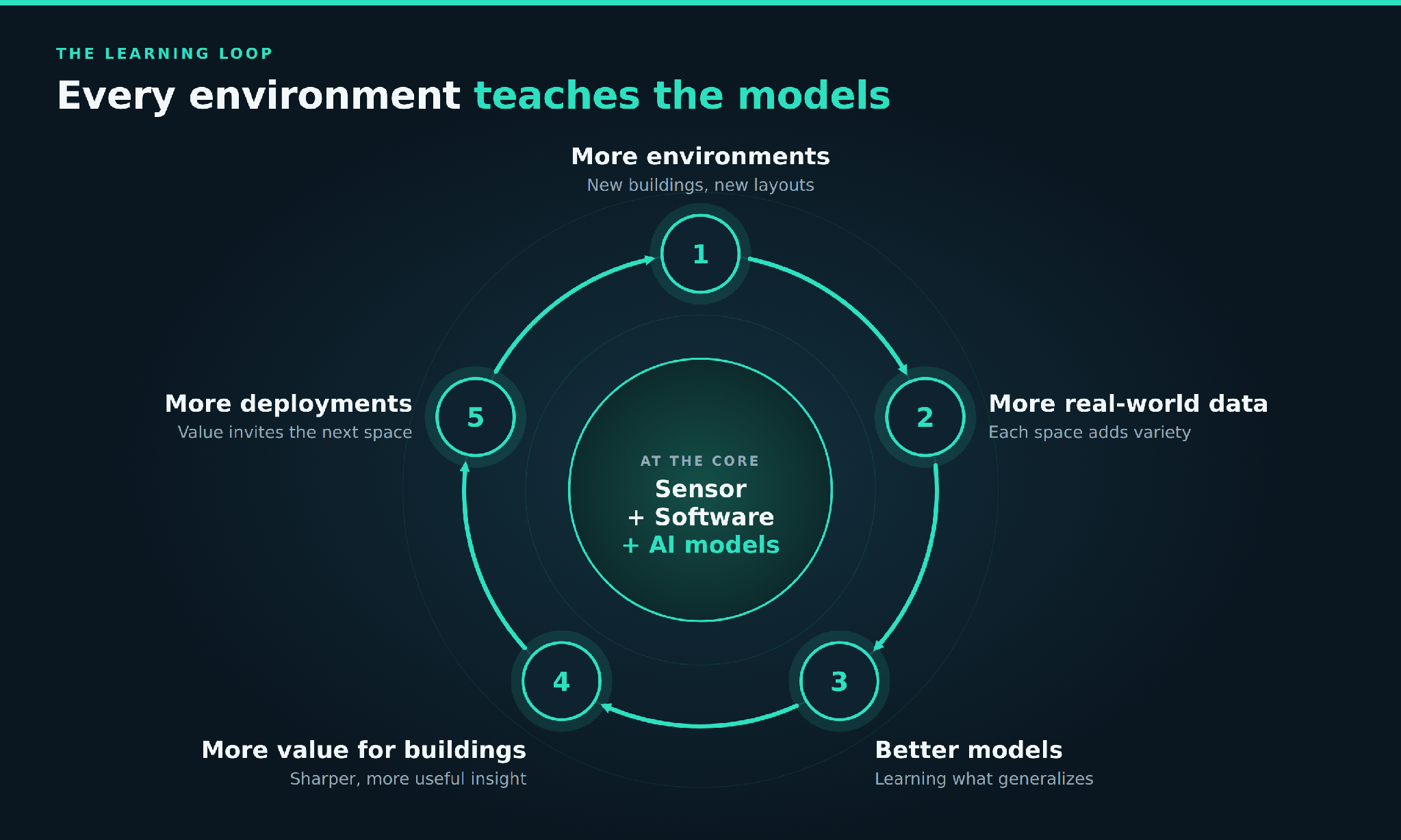
We're early in that loop. But we can already see why the combination matters. Hardware, software and models each improve when they learn from one another, and from the variety of places they're deployed.
We're also fortunate to learn from people who helped shape Wi-Fi itself. One of our senior advisors, Sarosh Vesuna, was a founding board member of the Wi-Fi Alliance and a co-author of the 802.11 MAC protocol. Watching Wi-Fi take on this next role is a meaningful moment for all of us.
A question worth asking
This is where our curiosity really kicks in.
Today, most sensing systems need some tuning for each new space. But AI has a habit of generalizing once it has seen enough variety. Language models learned to handle topics they were never explicitly trained on. So we find ourselves asking:
What happens when a model has learned from enough real buildings that it understands a new one on day one?
Researchers call that kind of capability zero-shot: working well in situations a model hasn't seen before. If something like that becomes possible for spatial awareness, a few interesting things could follow:
- Spatial intelligence could reach many more kinds of wireless hardware, including standard 802.11bf devices.
- A general understanding of how people move through space could become a building block for robots, smart buildings, care settings and industrial automation.
- Buildings could become partners in teaching physical AI, not only places that use it.
We don't know exactly when or how this unfolds. What we do see is that the path appears to run through real deployments in many diverse spaces, over time. That's the road we're on, and we're excited about where it might lead.
Why we're excited
Wi-Fi has spent nearly three decades connecting people to information. Now it's showing signs of a second role: helping buildings and machines understand the spaces we share with them.
Whether you're an investor, a Wi-Fi veteran, an AI builder or simply curious, this convergence is worth watching. The near-term benefits are practical, like smarter space decisions and lower energy use. The longer-term possibilities feel even bigger.
We're learning more with every deployment, and we'll keep sharing what we see. If any of this sparks an idea or a question, we'd love to hear from you.
Sources
- NVIDIA launches Cosmos 3 (Jun 1, 2026)
- ADT acquires Origin AI (Feb 24, 2026)
- IEEE 802.11bf-2025, published Sep 26, 2025
- Figure announces strategic partnership with Brookfield (Sep 17, 2025)
- NVIDIA launches Cosmos world foundation model platform (Jan 2025)
- Wi-Fi Alliance: founders share the story of the early days of Wi-Fi
- Toronto deployment figures: Aqusense internal data
Interested in where Wi-Fi sensing and physical AI are heading?
Start a Conversation