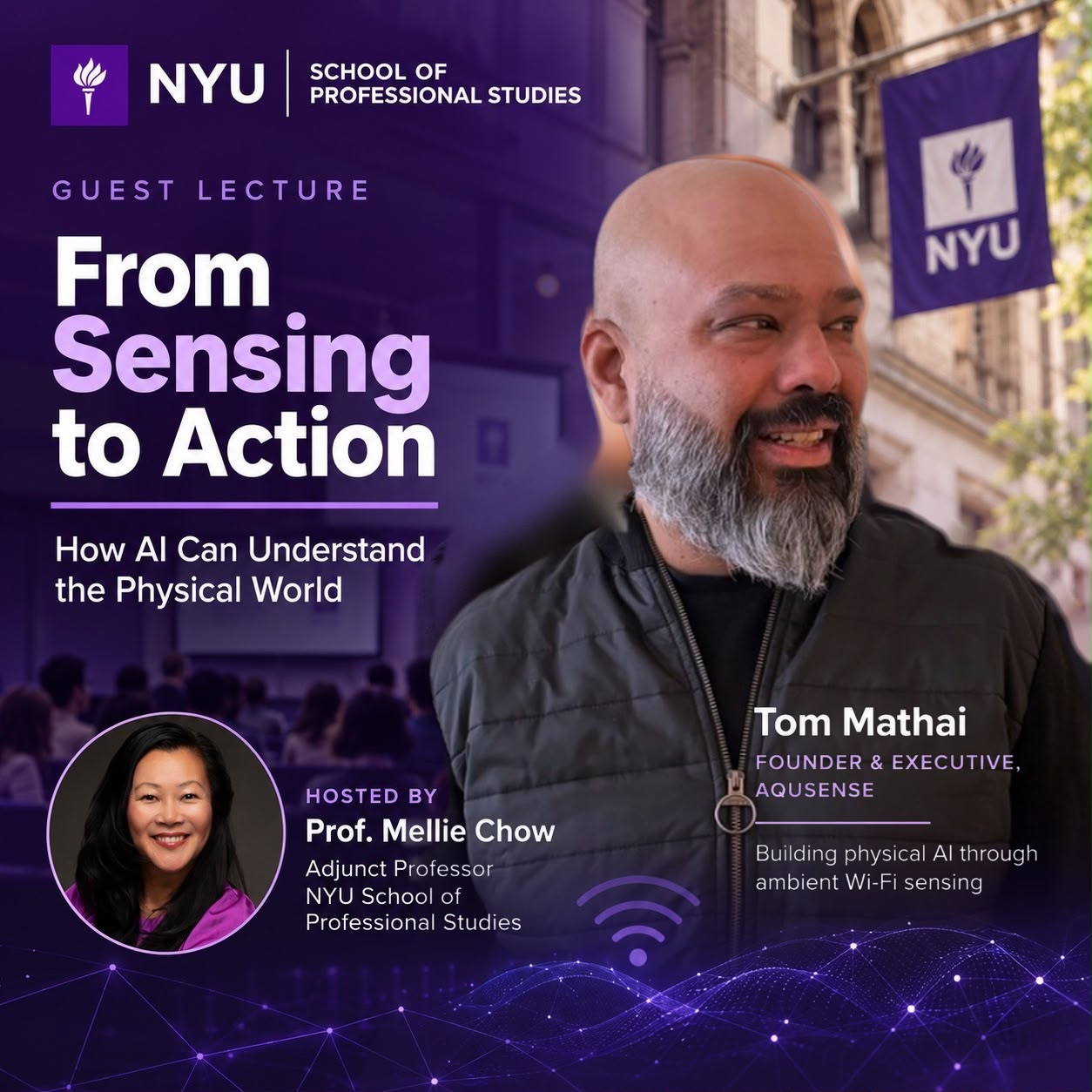
Aqusense at NYU: How AI Can Understand the Physical World
Tom Mathai, Aqusense CEO · Hosted by Professor Mellie Chow, NYU SPS
Wi-Fi has spent three decades moving data. At Aqusense, we believe its next chapter is understanding the physical world, and that this shift will become one of the foundational layers of physical AI.
Our CEO, Tom Mathai, took that message to New York University's School of Professional Studies as a guest lecturer on September 30, 2026, at the invitation of Adjunct Professor Mellie Chow. He shared how Aqusense is turning existing wireless infrastructure into real-time environmental intelligence, and why this technology matters for the next generation of AI. The students brought what the best forums always bring; sharp questions, healthy debate and a clear view of what it will take for this technology to earn its place.
Why Aqusense was invited
Emerging Technologies (MASY1-GC1800), part of NYU SPS's MS in Management and Analytics, examines how new and rapidly evolving technologies reshape organizations. Students study disruption, how to design and implement projects around new technologies, and the legal and privacy issues that follow.
Few technologies illustrate that arc better than Wi-Fi sensing, and Aqusense is one of those few companies at the frontier building:
- A new capability on existing infrastructure: Billions of Wi-Fi devices are already deployed. Aqusense turns those signals into intelligence without cameras or wearables.
- Real-world adoption, now: Organizations in smart buildings, workplace safety, logistics and secure facilities are evaluating and testing deployments.
- A category still being defined: Standards, regulation and best practice are taking shape in real time, which is exactly what the course asks students to analyze.
Aqusense offered the class a case study; a category-defining technology at the moment it moves from research into the real world. For students learning to evaluate technologies as they shift from promise to practice, it was an inside view of a category being defined in real time, along with the hard questions about privacy and trust that every emerging technology must answer.
Wi-Fi sensing: a foundation layer for Physical AI
AI has mastered language and images. Its next frontier is the physical world: understanding spaces, movement and presence, and responding in real time. That is physical AI, and it needs a way to perceive.
Cameras have been the default, but they carry real limits. They need line of sight and good lighting, they are costly to scale, and they capture identifiable images of people. Tom showed the class a different path: Ambient Wi-Fi sensing.
Every Wi-Fi signal is subtly disturbed as people move through a space. Aqusense uses AI to read those disturbances and turn them into actionable insight:
- Presence: whether a space is occupied
- Motion: how people move through it
- Micro-movement: fine signals that, in some settings, can include breathing and heart rate
No cameras. No wearables. Often no new hardware, because the infrastructure is already in the ceiling.
Existing Wi-Fi signals become real-time insight
- 1. Wi-Fi signalExisting access points fill a room
- 2. DisturbancePeople moving alter the signal
- 3. AIModels interpret the changes
- 4. InsightPresence, motion and micro-movement
Where Aqusense fits: Our PoE-powered platform is designed as a foundational AI layer for sensing the physical world. Its Human Presence Detection and Human Motion Detection and Environmental Awareness capabilities turn existing Wi-Fi signals into real-time insight. Potential applications span smart buildings, workplace safety, logistics, secure facilities, remote wellness monitoring and sensor fusion for robotics.
Where the industry is heading: Wi-Fi sensing is moving from research into the mainstream. IEEE 802.11bf brings sensing formally into the Wi-Fi standard, creating common ground for how devices coordinate it. Researchers are building foundation models for wireless sensing. Aqusense is building at the intersection of both: commercial-grade sensing today, designed to grow as the standards and models mature.
We explored this convergence in more depth in our recent article, Where Wi-Fi Sensing Meets Physical AI: What We're Seeing at the Convergence. The NYU session put those ideas in front of a new audience, and the discussion that followed showed how much interest there is in where this convergence leads.
The classroom as a forum for future innovators
A university classroom is one of the best places to test an emerging technology. Students are not customers or competitors. They are future executives, analysts, founders and policymakers, and they engage with new ideas on their merits.
That makes sessions like this a valuable platform for open discussion and debate:
- It stress-tests the story: A technology that holds up to a room of sharp, unconvinced graduate students is ready for the boardroom.
- It widens the conversation: Students weigh impact on people and society, not only on the bottom line.
- It shapes the field: The people in that room will lead the organizations that adopt, govern and build on physical AI. Engaging them now helps the whole category mature.
Aqusense is proud to contribute to that conversation, and to help prepare the next generation of leaders to think critically about the technologies they will one day deploy.
The debate: potential and privacy
The students quickly grasped the potential: buildings that respond to how they are actually used, safer workplaces, and independent living for older adults without a camera in the room. Many saw Wi-Fi sensing as a more privacy-conscious alternative to the camera-based systems it could replace.
The discussion then turned to the question at the heart of the category:
If AI can eventually detect human movement, breathing patterns and potentially even identify individuals without cameras, what does that mean for privacy?
It is the right question, and it led to a strong debate on the issues every emerging technology must work through:
- Invisible sensing: A camera is visible. A Wi-Fi signal is not. How do people know when sensing is active?
- Consent in shared spaces: In offices, hospitals and apartment buildings, who decides on behalf of everyone?
- Capability growth: As models improve, how do we keep a system used for its intended purpose?
- Identification: Can movement data stay anonymous as patterns become richer?
- Regulation catching up: Privacy law was largely written for cameras and personal data fields, not radio signals.
These aren't reasons to slow innovation. They are the boundaries any foundational technology meets on its way to maturity, and the industry will define how they are addressed.
Leading responsibly as the standards evolve
Every category-defining technology reaches the edges of existing norms. Aqusense is building to lead through that phase.
Our commitments:
- Building with the industry: As a member of the Wi-Fi Alliance, we become educated on how Wi-Fi sensing evolves, and we align as standards such as IEEE 802.11bf mature.
- Privacy that evolves with the technology: As capabilities advance, so will our privacy practices, guided by emerging regulation, standards and best practice.
- Collaborating with customers: We work with each customer to define how sensing is used responsibly in their environment and for their purpose.
- Open to dialogue: We openly engage with researchers, regulators and academic forums so that innovation and trust advance together.
The future of physical AI will be shaped by how responsibly its intelligence is used. Aqusense intends to help set that bar.
Thank you
A heartfelt thank you to Professor Mellie Chow for the invitation and for organizing the session, and for creating a classroom where emerging technology is examined with both curiosity and rigour.
Thank you as well to the students of Emerging Technologies for an engaged, thoughtful discussion. Forums like this are where the future of a technology is debated in the open, and we were glad to be part of it.
We appreciated the opportunity to share the Aqusense journey, and we look forward to continuing the conversation as Wi-Fi sensing becomes a foundation for physical AI.
An open invitation to educators
Conversations like this one shouldn't be one-offs. Aqusense extends a standing invitation to universities and programs teaching emerging technology, AI ethics, smart buildings and related fields. We are glad to join your classroom, in person or virtually, for:
- Guest lectures on Wi-Fi sensing and the future of physical AI
- Case studies on bringing a category-defining technology to market
- Panels and debates on privacy, ethics and responsible innovation
- Student projects exploring real-world, privacy-preserving use cases
Educators interested in hosting a session can reach us here.
Start a Conversation